Wednesday, August 29, 2007

The power of rhetorics....no.2

But evil in a sweet, beautiful, warm, exciting kind of way...

-Manolo

From Thales to Newton...(more to follow)

-John

Wednesday, August 22, 2007

...pray the lord my soul to take...


Many of us are familiar with this prayer through our religious catechism, our family, or Metallica. Every prayer though should end with "..and may your word be done". I do not want to wonder into why people pray. I want to ask what we can expect on a practical level from praying?

In my mind everything has already been played. God sees ALL of time laid out in front of him/her. Asking the deity to change something for us is meaningless cause God does not interfere in our life, thus free will is his/her ultimate gift. The ancient Greeks had a saying that we use until today and goes like : "syn Athena kai xeira kinei". It means that God will help those who help themselves. Schopenhauer says that there can be no happiness in this life. But man can be heroic and that is the highest man can attain to. Being heroic, what does this mean? It means knowing everything has already happened. It means accepting whatever the future has in store for you. It means knowing all that and still making dreams, fighting for your chance and your success and putting all yourself into defying all odds and making your goals real. Because after all we do not know our destiny until the moment it is revealed to us. No matter what we wish for not all of us can have health, success, money, fame etc. Someone has to die, be sick and poor. Not all of us can get our prayers answered and there is no sense in turning against the deity.

Until then we can ask the God/Allah/Yahweh/Buddha not to do for us but to give us the strength to go on and keep working towards our every goal without being discouraged of what might be the result of our efforts. Everything has been played out already, but in the words of Rocky Balboa "It aint over till its over kid".

-JimB

Tuesday, August 14, 2007

great minds....destroy alike

You could say that the importance of the best religious and philosophical minds is evident by the destructiveness of their worst and most fanatical followers. This must be the top 3 names of individuals who, contrary to intention, have caused humanity a great deal of pain:

- Jesus Christ (Crusades, Conquistadors, Holy Inquisition)
- Friedrich W. Nietzsche (Nazis)
- Karl Marx (Communist Russia)


-JimB


Tuesday, August 7, 2007

Victor Hugo...truly yours

Beautiful quote about really falling in love:

" I met in the street a very poor young man who was in love. His hat was old, his coat worn, his cloak was out at the elbows, the water passed through his shoes, - and the stars through his soul".


In our life we float here and there as in an ocean with no land ahead. Two things we need to survive: philosophy to put solid ground under our feet, and art that lifts our body and spirit to the sky.

-John

Thursday, August 2, 2007

1%...maybe more


The most famous argument for the degrees of similarity between humans and their close primate relatives, the chimpanzees has been out of a ground-breaking paper published in 1975 in Science. There evolutionary biologist Allan Wilson of UC Berkeley argued that humans where only 1% genetically different to chimpanzees.

An article under the NewsFocus section of the Science magazine published on 6/29/07 (vol.316, p.1836) reports otherwise. I will not follow the article and get into the scientific reasons for not believing the 1% myth. I will give another example that I hope will clear the air. Let me say to those who don't know me that I am not a young creationist. On the contrary, I believe in evolution. However the "1%" argument put forward by people trying to generate love and respect for our fellow animals is not entirely true. I back the motives but not the false argument.

Imagine that both humans and chimps are building ships. It is something they both know how to do. Each group possesses an ancient book with all the information on ship construction. The human book has 24 chapters and 1000 pages, whereas the chimp book has 10 chapters and 200 pages. Humans got a hold of the chimp book and compared it to their own. In it they found that the in the 10 chapters of the chimp book where many almost identical instructional passages to the human book. When comparing these passages word for word they found them to be 99% similar (1% different). Nevertheless the human book contained new passages and some of the old had been enriched in more detailed explanations on the science behind building ships. The human book has 14 more chapters and 800 more pages. The human book also has some quizzes and comic strips in it, and also other passages that don't make much sense. The fact though is that in these 800 extra pages many are very relevant to ship construction.

Just because the passages that are common between the two books are only 1% different, it does not mean that the whole books are 1% different.


-JimB

Thursday, July 5, 2007

Avoiding the unavoidable...

What does avoiding a future accident, or encounter, or a mishap mean? Is there a destiny? Do the stars hold the secret to our future? And if they do can we change our future? Is everything set in stone for us? Are every accident and experience a necessary part of our essence and thus without it we do not exist (Leibniz)?

The question is very well-known, tedious and without an answer. My purpose is not to get into an extensive conversation on wether free will exists, or wether everything is already determined for us by a higher being (God). There is a multitude of theories on destiny, God, the shape and nature of time and so forth. I want to illustrate with one example the limitations of thinking about preventing future events and altering our fate, if such thing exists. My questions is the following: how can we avoid what has not happened?

It is a question asked again and again by the likes of Baruch (Benedict) Spinoza and Daniel Dennett. Is there any point is worrying about the future and trying to avoid certain disasters? This depends on weather we believe that time is one line that has been carved on stone from beginning to end and all events (at least to a higher intelligence) appear at once and in their entirety. If we don't believe this it follows we may be able to change the future as long as we know what is in store for us given we take no further action to change it. But how can we get a glimpse of what hasn't happened. I am not sure if this logical paradox is addressed by physics and unfortunately my poor grasp of that science does not allow me to continue the conversation.

If, however, we believe in a
sub quadam specie aeternitatis where all has been already planed and is interconnected and cannot be otherwise, the concept of avoiding collapses. We cannot avoid what was never meant to happen. We, in our limited mental capacity perhaps feared it may happen but it would have never happened.


Example: I walk on the street and I decide to take a left turn instead of a right, and on the right turn a lampost collapses.
I have two choices as of how to percieve this event. I could say that I avoided a major head injury, or that there is no way I would have been hit by that lampost. We are not interested here in which way of thinking is more practical, or spiritualy favorable. The fact is that since I took a left turn the lampost never hit me. So I did not avoid it hiting me. The best we can say to the efect of avoidace is this : I had a 50-50 chance of going either way. So there was a 50% chance of getting hit by the lampost (although at the time of the decision I did not know for sure the lampost would fall). In reality someone would say that there is no predetermined fate and so we should follow the law of probability. According to that I had a 50% chance of getting hit by the lampost and I avoided it. If we chose to follow this line of reasoning then every time we step out of our house, or take a step to every direction we have to calculate the chances of any bad thing happening to us, which are infinite. In fact there are so many that if the law of probability holds true we should have something happening to us all the time. However my theory does not distinguish between small anomalies (stepping with shoes on a sharp stone) and big ones (getting hit by a car). Taking into account the most minute ones the law of probability looks better.


So although the "avoidance" seems more reasonable than thinking "it wasn't meant to be", in reality it is as least as impractical (should we chose to make a habbit of it).

-JimB

Thursday, June 21, 2007

To own, or not to own....?


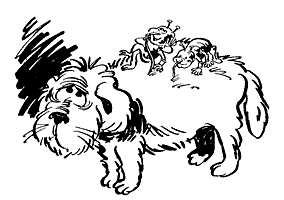
I do not recall who said it, though I have read it in Nietzsche's works: "Arguing over land is like two fleas on the back of a dog arguing over who the dog belongs to..."

And did you know that the Native Americans do not have a word for "owning land"? Remarkable isn't it. I bet the white folks who came first to the US were delighted to learn that. It definitely gave them a certain moral leeway, which is necessary when you want to scam someone, let alone a whole race of people. I mean they thought: "How can I steal from someone who lays no claim on what I want to steal"?

Native Americans were all around North America too, contrary to what people like me, not having learned ever much about Native American history, believe. They didn't occupy a couple of dozen villages. They lived all over North America and were made of many different tribes so the colonizers really outdid themselves in suppressing the natives. Enough with history and politics though. It is certainly not the purpose of this blog to discuss historic injustice done (just remember that the WWII was not the only dark period of humanity- sadly there were even worse in my opinion).

Do we own anything? The question can extend to both the realms of secular and spiritual things. There are two types of ownership we could say similar and different in ways. There is physical ownership which refers to earthly possessions such as a house, a car, a baseball bat. There is then spiritual ownership which refers to the feeling of owning spiritual and emotional objects such as the love of your spouse.

The two kinds of ownership are different foremost in the way that law views them. Secular objects are ascribed to an owner and there are legally binding contracts that uphold the ownership. For example if someone breaks into my car and drive sit without my consent he is considered a burglar. This car belonged to me because I bought it and the paper of its ownership was transfered to me by the manufacturer. The law protects and upholds that agreement between the manufacturer and me the owner. Thus the burglar is breaking the law when he/she takes my car without my prior consent.

I think Rousseau said that : the first man who put a fence around a piece of land and claimed it was his, and was able to convince a number of people of it, was the inventor of society.

Spiritual ownership is different in the sense that the law does not always protect the agreement between the two participants and thus any of the two can brake such a virtual contract at any time with no legal re precautions. There maybe though other ill-effects such as social stigma and a damaged reputation leading to further mistrust of the perpetrator by the rest of the community.

I maintain that both types of ownership are plasmatic and result from the need for physical and emotional stability that humans try to create in their lives. Through marriage, a stable working environment and our circle of friends we try to shelter ourselves. Even with our houses we try to protect ourselves, cover ourselves and establish strong bonds with other individuals. Why? I believe it all happens because of human fear of death.

In a world where the only sure thing is death, we try to create other forms of certainty to ease our fears and insecurities.

This is exactly why many philosophers such as, but not limited to, Bhudda, Epicuros, and the Stoics stressed continuously the importance of releasing ourselves from any form and feeling of ownership and possession in this life.

-Christoff

Wednesday, June 20, 2007

The power of rhetorics...

.....enough said

-Manolo

Thursday, June 14, 2007

Who is a philosopher?


"With a little more deliberation in the choice of their pursuits, all men would perhaps become essentially students and observers, for certainly their nature and destiny are interesting to all alike".

Henry David Thoreau
-Walden- (1854)


So who is a philosopher?

A philosopher is any man who loves wisdom and knowledge. In Greek the word 'philosophia' means "friend of wisdom". Knowledge is often substituted for wisdom in our modern interpretation of the term philosophy. Is that right?

Wisdom is not necessarily defined as knowledge. Wisdom is in my mind more closely associated with scientific providence. It is the accumulation of experience through life, and the successful application of this experience, in addition to factual knowledge and educated estimate, in tackling and solving new problems, or anticipate and prevent future ones.

It is in this sense that wisdom does not absolutely describe a learned individual. The best word to describe such one is 'philomatheis'. Philomatheia is the Greek word for 'friend of learning'. But learning in its strict sense can happen through books too. However, no one would consider a librarian necessarily wise. It is one thing to read books and journals and quite another to absorb knowledge and readily use it in combination with current information to apply it to real situations. This is wisdom.

Philosophy is then for everybody. Everyone who has ever asked 'why are we here?', 'Is there a God?', and the likes of questions given birth to by the mind of a teenager is a philosopher. Philosophy is a necessity much like food and water. To evaluate our life in every stage, to assess who we are and where we are, where we come from and where we are going and how we will get there, are all questions answered by philosophy. Even in order to establish our basic needs and prioritize them we delve into philosophy (Thoreau did it in a great extent in Walden).

In the words of Bertrand Russell:
" To teach how to live without certainty, and yet without being paralyzed by hesitation, is perhaps the chief thing that philosophy , in our age, can still do for those who study it".


John